Graduate School of Medical Sciences
A partnership with the Sloan Kettering Institute

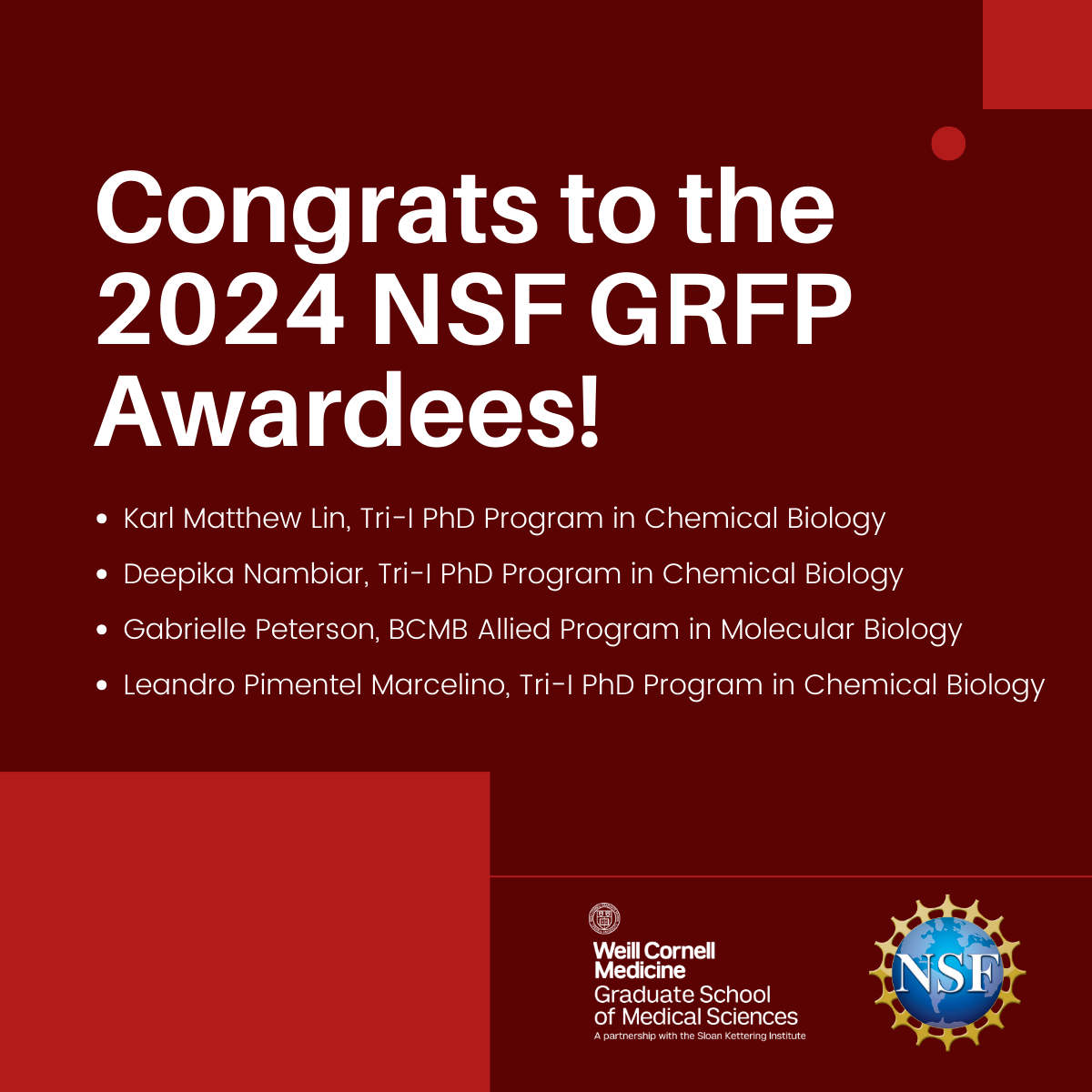
2024 NSF GRFP Awardees and Honorable Mentions

Congratulations to the 2024 NSF GRFP awardees and honorable mentions from our Weill Cornell Grad School community.

Human Neuron Model Paves the Way for New Alzheimer’s Therapies

Weill Cornell Medicine scientists have developed an innovative human neuron model that robustly simulates the spread of tau protein aggregates in the brain—a process that drives cognitive decline in Alzheimer's disease and frontotemporal dementia. This new model has led to the identification of novel therapeutic targets that could potentially block tau spread.

The preclinical study, published April 5 in Cell, is a significant advancement in Alzheimer's disease research.

Discovery Suggests New Strategy Against Follicular Lymphoma

A team led by researchers at Weill Cornell Medicine has identified important drivers of the transformation of a type of blood cancer called follicular lymphoma from a slow-growing form to the aggressive form it takes in some patients.

The study, published March 7 in Cancer Cell, showed that while mutations affecting a gene-regulating complex called BAF can put the cancer on a dangerous trajectory, they also make follicular lymphoma highly susceptible to experimental BAF-inhibitor drugs.

Stand Up To Cancer Dream Team Collective Seeks to Transform Care of Gastroesophageal Cancer

A collaboration between Dr. Jedd Wolchok, the Meyer Director of the Sandra and Edward Meyer Cancer Center at Weill Cornell Medicine, and Dr.

2024 Health Hackathon Yields Innovative Solutions for Enhancing Patient Safety

The 2024 Health Hackathon brought together 185 students with diverse backgrounds from Cornell and 26 other universities—in just 36 hours, they addressed critical safety challenges facing patients today.

NSF Awards Grant for Evolution-inspired Design of Therapeutic RNAs

A team led by Dr. Samie Jaffrey, the Greenberg-Starr Professor of Pharmacology at Weill Cornell Medicine, has been awarded a three-year, $1.65 million grant for RNA research under a biotechnology-development program run by the U.S. National Science Foundation.

Mapping the Evolution of Urinary Tract Cancer Cells

Researchers at Weill Cornell Medicine have performed the most comprehensive analysis to date of cancer of the ureters or the urine-collection cavities in the kidney, known as upper tract urothelial carcinoma (UTUC).  The study, which compared the characteristics of primary and metastatic tumors, provides new insights into the biology of these aggressive cancers and potential ways to treat them.

Peer Coaching Helps Marginalized Individuals Lower Blood Pressure

For younger Black patients living in rural parts of the Southeastern United States, peer coaching is more effective than traditional clinical care in controlling high blood pressure, according to a new study led by investigators at Weill Cornell Medicine and NewYork-Presbyterian. The investigators learned that for people under age 60 who have persistently uncontrolled hypertension, the benefits of working with a peer health coach were equivalent to what would be expected from taking a low dose of blood pressure medication.